 Business License
QCM922 Quartz Crystal Microbalance
General
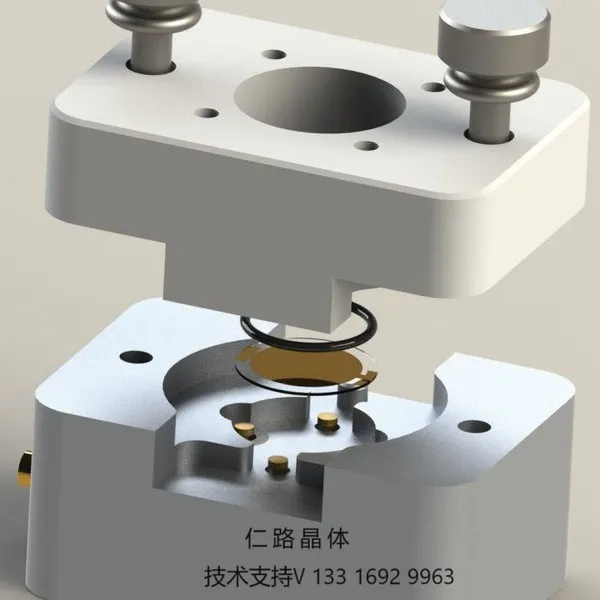
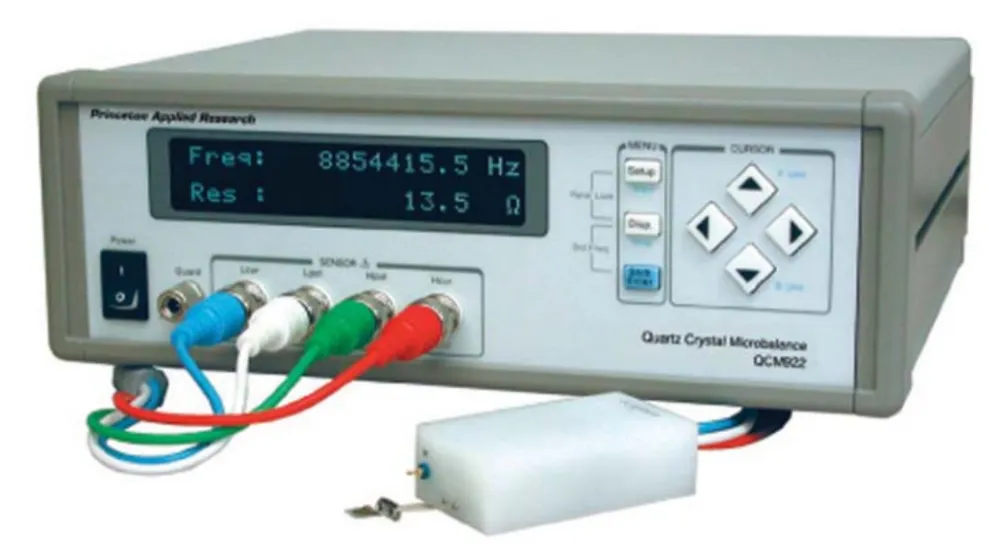
Princeton Applied Research is proud to offer the QCM922 Quartz Crystal Microbalance. The QCM922, an instrument developed for piezoelectric gravimetry in the ng-µg regions, monitors both the resonant frequency and resonant resistance of a Pt or Au coated AT-cut quartz crystal. The resonant frequency changes with the effective surface mass on the crystal, and the resonant resistance changes with the viscosity of the material interfacing with the surface of the quartz crystal. Capable of covering a wide range of applications, the QCM922 was developed primarily for applications where it is used in conjunction with a potentiostat/galvanostat as an Electrochemical Quartz Crystal Microbalance (EQCM). Applications With the addition of a Princeton Applied Research potentiostat/galvanostat, the QCM922 system (with the Pt or Au coated resonator serving as the working electrode) can provide information on potential, current, charge, resonant frequency (mass), and resonant resistance (viscosity) simultaneously. This allows researchers to analyze electrochemical depositions, polymer fi lms formation on electrodes, corrosion, adsorption and electrochemical reaction mechanisms. Other application areas include battery research, electroplating and biosensor development. System Description The QCM922 comes calibrated to operate with 9MHz ATcut quartz crystal resonators1. This frequency range is suffi cient to provide ng level measurements2 while still working with a crystal thickness that is not extremely fragile. The frequency resolution is 0.1 Hz at a sampling rate of 100 ms, allowing for excellent sensitivity down into the ng region. Sensitivity is based not only on the resolution and stability of the instrument, but also on the application and experimental design (i.e., proper shielding). For instance, the QCM922 includes a crystal holder that is extremely fl exible in application use. It can be used as a well cell ( 0.5 mL volume), a dip cell into a larger beaker, mated to a larger cell, or incorporated into a fl ow-through system of users design.
Data Collection and Software Options
Front Panel: The QCM922 has a 2-row front panel display capable of showing any two of resonant frequency, resonant resistance, or frequency. There is also a setup menu that allows the user to confi gure the system independent of any control software. Analog Outputs: In addition to the actual measured data appearing on the front panel, there are two analog channels on the rear panel that provide an analog voltage output that correlates with the resonant resistance and the frequency values. The data from these outputs can be collected with the Auxiliary Inputs of the Princeton Applied Research potentiostat and its supporting software, simultaneously with the potential, current, or charge values when performing EQCM experiments. Computer Interface: There are two computer interface options on the rear panel, one for RS-232 and another for GPIB. The control commands are available in the documentation provided for the QCM922 for those interested in developing their own programs for computer operation. WinEchem Software: The optional WinEchem software can control the QCM922 (or the predecessor QCA917) stand-alone, as well as the Princeton Applied Research potentiostat/galvanostat Models 263, 263A, 273, 273A and 283. The software can control the QCM922 and the potentiostat independently, or simultaneously for EQCM experiments. The electrochemical techniques available in the WinEchem software are CV, LSV, CA, CC, CE and Ecorr, with scan rates for this software from 1 mV/sec to 1 V/sec. With the WinEchem software, up to four graphs can be displayed from a single fi le, or a single graph can be displayed from each of four different fi les. The data storage format is either a binary fi le, or a comma delimited ASCII fi le that opens directly into Microsoft® Excel.
Accessories
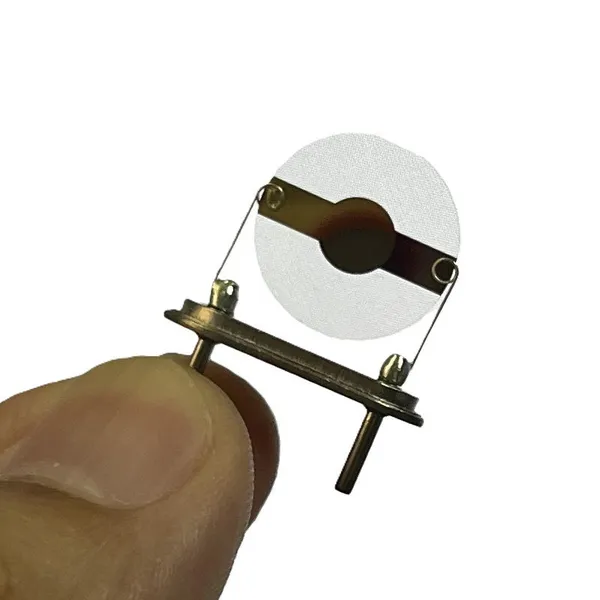
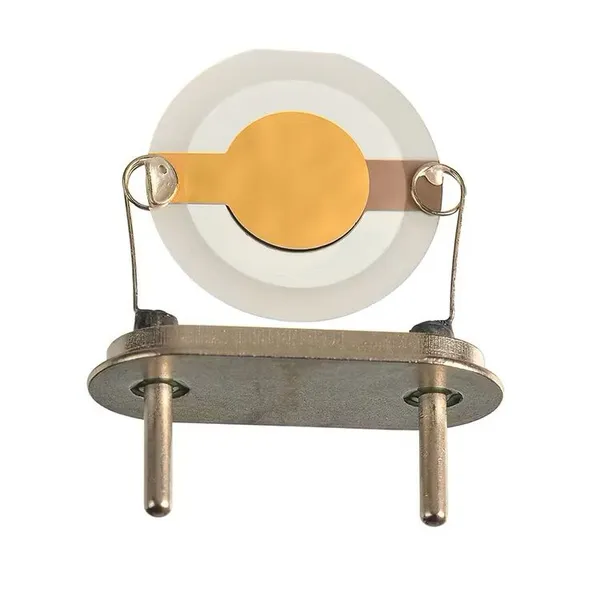
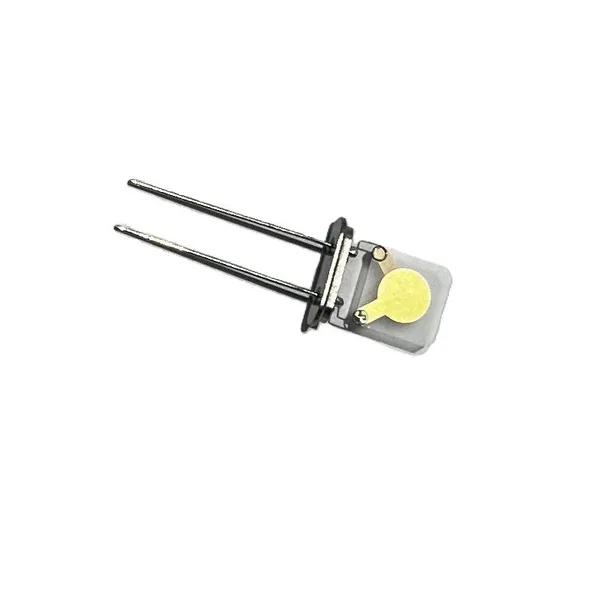
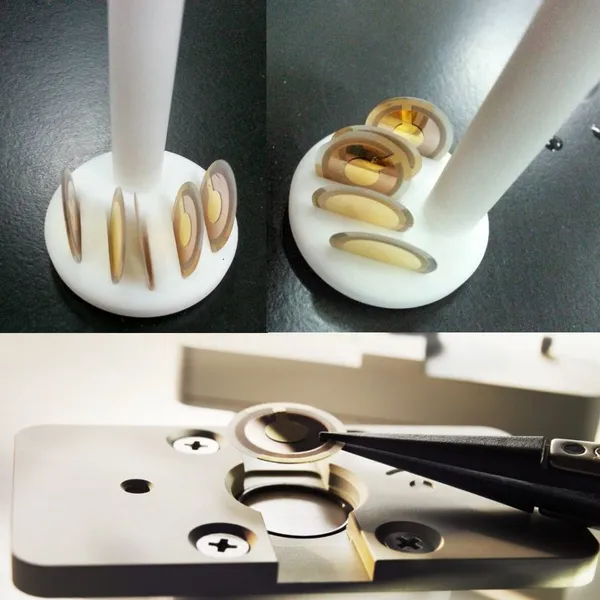
Quartz Crystals 9MHz AT-cut: Gold or Platinum sputtered on Ti (Microbalance Tek) Electrode Area: 0.2 cm2 Electrode Thickness: Au or Pt ~300 nm Analog Outputs ∆F Output: Full Scale: ±10 V (12 bit) ±200 kHz Range ±20 kHz Range ±2 kHz Range ±200 Hz Rnage Resistance Output: Full Scale ±10 V (12 bit) 1/2/4/8/16 kΩ Ranges Software Two options: 1) Either the VersaStudio or PowerSuite software can be used to control the Princeton Applied Research potentiostat/galvanoststs, and the data collected from the QCM via the QCM922’s analog outputs into the potentiostats Aux Input. See the PowerSuite brochures for applications and computer requirements. 2) Also available, WinEchem, a software package capable of controlling the QCM922 stand alone, or in conjunction with certain Princeton Applied Research potentiostat/galvanostats to perform routine electrochemical techniques simultaneous with QCM measurements.

Contact Us
Recommended Products
-
 QCM Sensor Crystal, Gold 5MHz for Biolin Q-sense QCM-D and EQCMNegotiableMOQ: 10 Blades
 -
QCM Sensor Crystal, Gold 7.995MHz for CHI EQCMNegotiableMOQ: 10 Blades
-
QCM Sensor Crystal, Gold 6MHz for Metrohm Autolab EQCMNegotiableMOQ: 10 Blades
-
QCM Sensor Crystal, Gold 9MHz/10MHz QCM922/934 EQCMNegotiableMOQ: 10 Blades
-
Quartz Crystal Microbalance QCM Sensor 5MHz 1 Inch, QCM200/QCM300 EQCMNegotiableMOQ: 10 Blades